For the past few years, ever since generative AI tools became widely available, one question has kept coming up in embedded systems communities: Will AI replace embedded engineers?
The short answer is no. But AI is already changing the embedded systems market, and its impact will only grow. The real question is not whether embedded engineers will disappear or not, but how their workflow, tools, and required skill set will change. And how is it going to affect the job market for embedded systems? Will it create more jobs or the opposite?
The Fear: Will AI Replace Embedded Engineers?
The fear is understandable.
For the first time, we have tools that can write firmware code, navigate datasheets, generate peripheral drivers, suggest architectures, create test cases, and even help in debugging the actual hardware from a simple natural-language request. Tasks that used to take hours can now sometimes be done in minutes.
This fear is even stronger for junior engineers. If companies can use AI to generate simple drivers, example projects, documentation, and boilerplate code, will they still need as many entry-level engineers? And if senior engineers can move faster with AI assistants, will smaller teams be able to do the work that previously required larger firmware departments?
My perspective is that pure embedded software positions are the most exposed to AI disruption, while embedded hardware positions are relatively more protected, at least for now. Moving forward, the strongest position will be to build a broader skill set that combines firmware development with hardware understanding, debugging, testing, system integration, and product-level decision-making.
How Our View of AI in Embedded Systems Changed
At first, using AI to develop embedded software felt gimmicky. In the early wave of public generative AI tools, many engineers saw it as useful for simple examples, boilerplate code, or quick explanations, but not something you would trust for complex embedded systems projects.
Then the narrative shifted: “It works if you give it a detailed enough prompt and enough context.” Suddenly, the internet was flooded with “Prompt Engineering” courses that everyone was selling to the overhyped audience.
Then it changed to “We will become architects, and AI will be the coder that implements our designs.” I was one of the advocates of this approach, and at the time, it sounded very reasonable. The engineer would define the architecture, constraints, interfaces, and tradeoffs, while the AI would handle much of the implementation.
But the models kept improving. They became better not only at writing code but also at suggesting architectures, identifying missing requirements, comparing design options, and making reasonable implementation decisions when given enough context.
Now the interaction is moving closer to natural language. You describe what you need, and an AI agent can often ask follow-up questions, infer missing requirements, propose an architecture, and start implementing the system. Of course, detailed prompts and rich context still produce better results, especially in embedded systems where hardware constraints matter. But the point is clear: AI is no longer just a fancy autocomplete tool.
It is changing how we design and build embedded systems, and it will continue to let engineers move much faster than before. But the sheer speed of “coding” that we gained from AI use is faster than many teams can review, test, and validate. It exceeds the testing capacity, which in many places still has not changed from the pre-AI age. But that’s another discussion for later.
What AI Can Already Do Well For Embedded Engineers
Here are some of the tasks where AI is already proving useful in embedded systems projects across many domains.
- Generating Boilerplate Code: peripheral initialization, driver skeletons, HAL layers, RTOS task templates, and configuration code.
- Navigating Datasheets & Documentation: summarizing and finding information in long documents, and enforcing coding styles and guidelines.
- Debugging Software Issues: explaining compiler errors, reviewing build logs, identifying suspicious code patterns, suggesting possible causes of bugs, and also fixing them. With CLI access, the AI agent can build and flash the binary output to your embedded target microcontroller, which closes the loop and makes it less likely to hand in broken code.
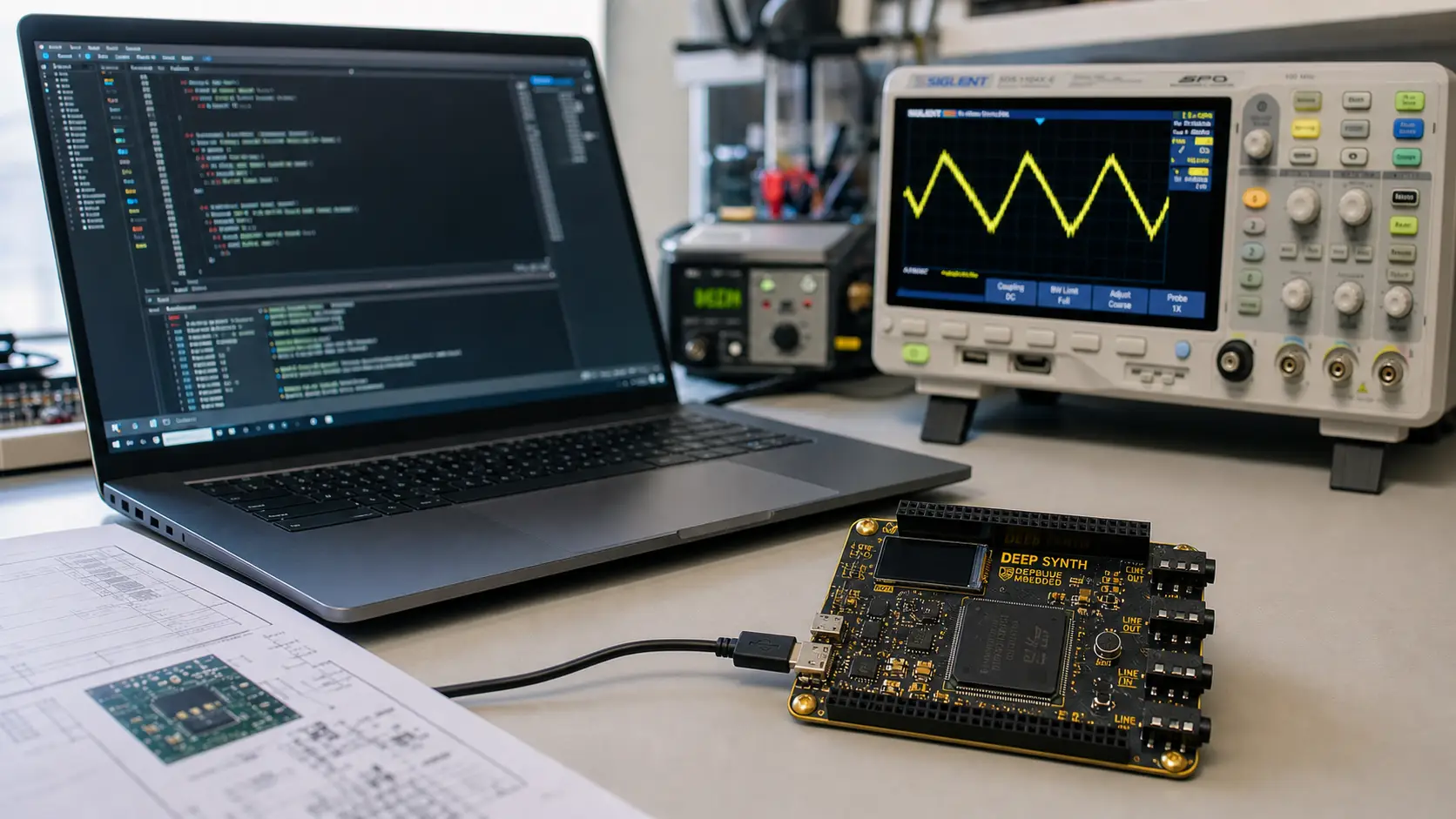
- Debugging Hardware Issues: I know this might sound like an unpopular opinion, but I’ve found it really helpful to use AI in my hardware work, and I will show you my setup and home lab network that enabled me to use AI even for hardware stuff that everyone thought it shouldn’t be able to.
- Creating Tests & Scripts: generating unit-test templates, Python automation scripts, log parsers, CLI tools, and hardware test routines.
- Improving Documentation: creating documentation files, API documentation, design notes, comments, and onboarding material.
- Supporting Learning & Research: explaining new concepts, comparing design decisions, reviewing unfamiliar SDKs, and helping junior engineers ramp up faster.
- Code Review Assistance: suggesting edge cases, missing error handling, race conditions, and places where the code may need more validation.
There are many more niche situations where AI can be useful in embedded systems, but these are the most common use cases I have seen in practice.
Where AI Still Struggles in Embedded Systems
There are many situations in embedded systems where current AI models are still not as helpful as people expect. The most common cases I have seen include the following:
- New or Obscure Parts: If you are dealing with relatively new components, target MCUs, interfaces, standards, or ICs with limited public documentation, AI becomes much less useful. The same applies to proprietary parts in legacy products that are still maintained by some companies. In these cases, you often have to rely on the datasheet, vendor support, lab measurements, and your own debugging process.
- Complex Systems: real embedded products often include large codebases, legacy components, hardware constraints, safety requirements, coding guidelines, build systems, test procedures, and product-specific assumptions. Even with a large context window, it’s still difficult for AI to keep track of all the relevant details. If it does not receive the right context, it can easily introduce bugs while modifying even a small part of the system.
- Highly Dynamic Test Environments: AI is less helpful when testing requires frequent physical intervention, changing connections, replacing parts, modifying the setup, pressing buttons, moving sensors, changing loads, or observing behavior over time.
- Visual-Heavy Documentation: many datasheets and application notes depend heavily on timing diagrams, charts, graphs, package drawings, layout recommendations, state diagrams, and waveform examples. AI tools often lose important information when these PDFs are converted into text-only input. This makes them weaker at tasks where the critical detail is visual rather than textual.
- Hardware Failures: AI can suggest possible hardware causes, but it often tends to keep searching for a software fix because software is the part it can modify most easily. This can lead to unnecessary retries, overcomplicated mitigation code, or wrong assumptions. In most cases, fixing the hardware itself, such as signal integrity, grounding, pull-up values, power stability, or layout, is much better than adding complex digital workarounds in firmware.
There are many more situations where AI struggles in embedded systems, but these are the most common ones I have seen in practice.
Which Embedded Tasks Are Most Vulnerable To AI
From what we have discussed so far, it is clear that software-heavy embedded tasks are the most exposed to AI automation. This does not mean that embedded software engineers will disappear, but it does mean that some parts of the job are becoming easier, faster, and cheaper to automate. So we’ll need fewer people doing these roles.
The most vulnerable tasks are usually the ones that are repetitive, well-documented, and easy to verify in isolation. Which includes:
- Boilerplate firmware
- Simple application logic
- Code migration and refactoring
- Documentation
- Test scripting
- Build & tooling scripts
Which Embedded Tasks/Skills Are AI Proof
The most valuable skills in the age of AI are the ones that involve real-world constraints, physical debugging, system tradeoffs, and engineering responsibility. Things like:
- System Architecture
- Dynamic Software Design (RTOS)
- Functional Safety & Compliance
- Hardware/Firmware integration
- Hardware Design/Debugging
These are the areas where embedded engineers remain highly valuable because the work is not just about generating code. It is about making a physical product behave correctly, reliably, and safely in the real world.
AI Effects on Embedded Systems Job Market
Another intriguing question posed by AI use in embedded systems is: Will AI create more Embedded Systems jobs, or will it reduce job vacancies? Or in other words, is Embedded systems still a good career in the age of AI?
The honest answer is mixed. Embedded systems is not collapsing as a career, and the long-term demand signals are still healthy. But the market is not exactly the same as it was before AI. Junior roles are harder to get, companies expect more productivity from smaller teams, and engineers who can use AI while still understanding hardware, debugging, testing, and system-level architecture & tradeoffs will have a clear advantage.
What I’ve seen across all the domains that I’ve worked with over the past years (automotive, consumer electronics, IoT, etc) is: bigger companies who’ve been part of the 2021-2023 tech hiring boom are more likely to be the ones who’re laying off the most right now. Not necessarily because of AI; it is one factor, but not the main driving force.
They have a more established process of development, a decent log of projects, code bases, IPs, issues/fixes, documentation, guidelines, and so much more input that can be used to give AI tools a context that helps them generate much better code than others. They also tend to have much better testing/validation setups and teams that can be expanded to handle the high volume of AI-generated code.
For startups and small companies, AI has lowered the barrier to entry by democratizing knowledge. More new players can now build demos, validate ideas, attract funding, and create embedded systems jobs.
These new roles help offset layoffs at larger companies, which is why I don’t think the embedded systems job market has been disrupted “by AI” as heavily as other tech areas.
Concluding Remarks
To wrap this up, I don’t believe AI is simply taking over embedded systems jobs. But it has already changed, and will continue to change, the way we design, build, test, and maintain embedded systems. It’s an extremely helpful tool if used properly, or it can waste your time if you hand it the steering wheel completely.
It’ll put pressure on “software-heavy” job vacancies, but still opens some other job opportunities that require engineers with a diverse skillset. And also by lowering the barrier of entry, we’re going to see more and more companies stepping into the embedded systems market, which in turn creates some more jobs to offset the layoffs at bigger companies that are cutting costs down.

Great insights. I used to believe that embedded systems, especially in domains like Automotive, has been always on the conservative side, but things are rapidly changing nowadays.
Glad you liked it ^^
As a fresh grad seeking an entry-level position, I can confirm the struggle of junior engineers nowadays. I really wanted to pursue embedded systems as a career but it seems like i’m giving up on it.
I’m really sorry to hear this. I’d say you still have some time to figure things out before deciding to shift away. Not all domains are hit as hard from what I’ve seen over the past 3 years.
The Automotive sector has shown significant disruption compared to other domains, and it accounts for a sizable number of the embeddded systems job market.
However, domains like defense, medical, edge AI, robotics, and others are showing some really good stats. I’d look into all of these options before making a final decision.
The point that AI now produces code faster than many teams can review and test it feels like the real bottleneck, more than job losses. I would like to see the home lab setup you mention for using AI on hardware debugging.